|
The general description
The small ancient Russian town Soligalich is located in Kostroma area on the right and left coasts of the river Kostroma in 90 km from the railway station Buj. In the beginning of the 14th century the people found here the precious hydrochloric sources and began to boil down the salt. In the 14-18th centuries Soligalich was a large Russian centre of salt manufacture.
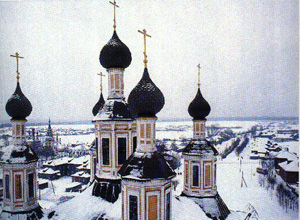 |
Nativity Cathedral. On the left-hand side you can see
the
Reserection Monastery with a belfry. |
On the basis of curative mineral waters opened in 1841 the medical resort was later founded. It exists now.
The town is interesting thanks to its history, its architectural monuments, survived to our times, the wood nature, and also to those natural riches, which are kept in the ground.
The most interesting monuments of ancient architecture are located on the right coast of the river Kostroma. The churches of former Voskresensky monastery reflect at a flat mirror of the water. In 300 ms the majestic Rozhdestvensky cathedral stands. On the other side among wooden houses the ancient temple of Nikola on Navolok (1688) is seen, near it there is the Preobrazhenskaja church (1821), below, closer to the river, there is the construction of mud resort.
The bridge located on a place of ancient one led to the left coast of the river, where now dim contours of mounds of the former fortress of Soligalich are seen.
Pages of history
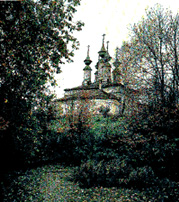 |
| Reserection Monastery Epiphany Church 1681 Ц.
|
It is not known, when for the first time salt was boiled down in these places, but in the will of Moscow prince Ivan Kalita (1332) there is a mention about Galich's salt trade. The local chronicles connect the foundation of the town Soligalich with the name of Galich's prince Fedor Semenovich, the descendant of Aleksander Nevsky, under the order of which in 1335 the Voskresensky monastery was built on the coast of the river Kostroma. The place for the monastery, and for the future town, was chosen not casually. The legend says, that in this place prince Afanasij have seen an unusual doe, then he ordered to erect here the church of Voznesenija. The prince generously presented the grounds to the monastery, and gave two third of the lake Chudskoje (Chuhklomskoje) and a quarter of Galichskoje lake in monastery usage, and he permitted fishing in all rivers.
The monastery grew rich, got salt trade, mills and arable lands. Destitute people reach for these places, a craft settlement became to grow around the monastery, for defence the building for the military people was put up. So there was the settlement of Galich Salt, which later received the name of the town Soligalich.
But in those times there were the ruinous local wars. After the devastating raids of Cheremiz's prince Nikita Baiboroda and the groups of Kazan Tartars the monastery was gradually ruined, lost its dominate role, conceding a place to the craft settlement.
In 1450 Soligalich was finally attached to Moscow great state. To protect the town from the Tartars invasion, on an opposite coast the fortress was constructed, and the earthen mounds eight-meter height were erected.
In 1532, during the great invasion of Kazan Tartars, the fortress was subjected to three-days siege, but it stood fast, and Tartar has receded. By a defence of fortress guns on the right coast of the river Kostroma the settlement developed. The favourable salt craft attracted in the town a lot of trade people, even six monasteries, including famous Troitse-Sergiev, had here their crafts.
In the beginning of the 17th century the Russian towns were ruined by Polish-Lithuanian groups. In 1613 Soligalich was undergone to an attack, too. The town was burned down, many people were killed or taken prisoner.
But in due course life was adjusted, in 1648-1649 the population of Soligalich, as well as other Russian towns, received the right of crafts and trade - "free tender". The trade connections quickened and the ships with salt and other goods floated on the river Kostroma. Soligalich appeared on one of the important river trade ways connected Volga with Arckangelsk - the sole seaport of Russia of that time. The bell of Voskresensky temple with an inscription in Latin language, made in Amsterdam in 1631, testify to trade connection of Soligalich with Western Europe.
The town developed on the right coast of the river. The trade square acquired new buildings, but the fire of 1649 destroyed all wooden churches, many trades and the houses. And only in 1660 the first stone temple of Soligalich - the Voskresensky cathedral - was constructed instead of the burned down wooden church.
On the left coast the wooden Uspenskaja church constructed simultaneously with the fortress in the 15th century was burned down, too. The stone Uspenskaja church (the sole on this coast) constructed in 1786 instead of burned one, unfortunately, was disassembled in 1930.
It is possible to familiarise with sights of modern Soligalich in detail in the following chapter.
Places of Interest
The stone temples of former Voskresensky monastery were under construction gradually, since 1660. The Voskresensky cathedral, the first monastery temple, was under construction nine years, when, at last, the stone drums crowned by five domes with carving crosses arisen above the battens roofs. The belfry of the temple, which was put forward to the settlement, majestically welcomed the pilgrims. The interior of the Voskresensky cathedral, unfortunately, has not kept its initial shape; only on the arch here and there the frescos are seen. Around some window the pattern of carving was well saved. The samples of a groove on the stone contained the patterns of wooden architecture and of the art of embroidery are survived to our time.
In 1681 one more monastery church - Bogojavlenskaja - was constructed. It is at some distance from the main Voskresensky cathedral. The unity of a composition and a sensation of a generality of two temples are felt. The domes of the Bogojavlenskaja church ensure its harmony.
The monastery cells and the fencing are not survived, only the century-old birches surround the place of the former monastery. From the opposite coast of the river the perfect view to the churches of the Voskresensky monastery opens in a halo of white night. The church domes seem to be chess figures, cut out from the black paper and standing on two huge boards.
Near the Voskresensky monastery closer to the trading square the temples of the Rozhdestvensky nunnery began to be under construction in 1668, and in 1805 the construction was terminated.
The discrepancy between the top part of the cathedral and breakage of the basis is significant. The different art style of the foremen of stone building is connected with a history of construction of this unique structure. The beginning of the construction of the cathedral in 1668 was connected with personal "diligence" of the empress Marija Iljinichna (Miloslavskaja), which, under the legend, spent her youth in these places. After her death there were not any means for construction of the temple. By 1701 the church of Rozhdestva Bogoroditsy was already constructed, the belfry with five stone bells and clock was joined to it, but the walls of the large temple of Rozhdestva Christova were incomplete. In 1764 the monastery was liquidated, and only in 1792 the Rozhdestvensky (Christmas) cathedral began to be completed. The architects and builders of the 18th century with other skills and new scientific knowledge during their works considered tactfully the labour of their predecessors, so the art expressiveness of a structure didn't suffered from the difference of styles at all.
In the part of the premises of the Rozhdestvensky (Christmas) cathedral and the church of the Rozhdestva Bogoroditsy there is an exposition of the museum of Local Lore.
Among the inhabitants of the Soligalich there were a lot of well-known people: the brave traveller G. I. Nevelsky, the known Russian singer P. A. Barteneva, the academician L. A. Serjakov, the famous publisher Ivan Sytin, the Russian artist of the 18th century Grigorij Ostrovsky, the great Russian composer A. P. Borodin, etc.
Let's take a walk on the Trade square and the small streets of the town. Certainly, the territory of ancient town undergone many changes. But wooden Trade court, survived up to our time, iron doors with forged volts, lonely stayed kerosene lantern and the Rozhdestvensky cathedral seen in the distance - all this create an impression of theatrical scenery.
On the first sight the streets of Soligalich are a little remarkable, but among the wooden houses there are the genuine masterpieces of national art of a tree groove. It is possible to see the unique patterns.
It is possible to take a walk to the most beautiful wood beginning directly behind the town. There on a road on the village Selejkino there are rare two-storeyed wooden barns, it is possible to see a shabby wooden cross of ancient work, and in the village Verkhny Berezovets it is possible to see a genuine pearl of ancient Russian architecture - the Iljinskaja church.
|



![[Soligalich]](soligalich/plan.gif)
![[Picture]](soligalich/gerb.gif)